

Dairy Processing Compliance Requirements in India — How Asiatic Traders Helps Meet Them

A dairy plant can lose market access faster from a missing licence, weak labelling record, or poor cold-chain log than from a production delay. In India, compliance is not a formality. It is the operating system that protects consumers, keeps brands credible, and allows milk, curd, paneer, ghee, cheese, butter, milk powder, and value-added products to move through the supply chain without disruption.
For dairy processors, the challenge is that Dairy Processing Compliance Requirements sit across several layers. FSSAI requirements cover food safety, product standards, hygiene, labelling, packaging, recall systems, and licensing. Other rules may apply to weights and measures, pollution control, worker safety, boilers, plastic packaging, and exports. A processor must keep daily operations aligned with all of them.
This is where Asiatic Traders plays a practical role. Through training, consultation, documentation support, vendor guidance, and compliance audits, the team helps dairy businesses understand which Dairy Processing Compliance Requirements apply to their operations, identify gaps, and prepare for inspections with greater confidence.

Dairy Processing Compliance Requirements in India.
Why dairy compliance in India needs a structured approach
Milk is highly perishable. It can spoil quickly if handling, temperature control, sanitation, or testing slips. Dairy products also reach children, hospitals, homes, sweet manufacturers, caterers, retailers, and export buyers. That makes regulatory scrutiny high and justified.
For processors, compliance affects several business functions:
Procurement
Raw milk collection, chilling, transport, supplier records, and quality checks.
Processing
Pasteurisation, fermentation, separation, homogenisation, drying, packing, and cleaning systems.
Testing
Fat, SNF, acidity, adulterants, microbiological quality, residues, and product-specific parameters.
Storage and distribution
Cold-chain controls, batch traceability, dispatch records, and shelf-life monitoring.
Market access
FSSAI licence status, correct labels, permitted claims, recall readiness, and buyer audits.
A processor that treats compliance as a one-time licence task often struggles during inspections, customer audits, or product complaints. A stronger approach builds compliance into daily routines. That means standard operating procedures, trained staff, maintained equipment, verified suppliers, and records that match actual practice.
This article is for information only and should not be treated as legal advice. Regulations can change, and businesses should verify requirements for their specific product category, scale, state, and market.
Key regulations dairy processors must follow
India’s dairy compliance framework starts with FSSAI, but it does not end there. The exact obligations depend on the business size, product range, location, packaging type, fuel systems, effluent output, and sales channels.
FSSAI licensing and registration
Under the Food Safety and Standards Act, 2006, food businesses must obtain the right FSSAI registration or licence before operating. Dairy processors usually require a State or Central FSSAI licence depending on scale, capacity, and business activity.
The licence must reflect the correct kind of business and product category. A plant making pasteurised milk may need updates if it later adds paneer, flavoured milk, curd, ghee, cheese, or milk powder. Changes in address, capacity, product range, or business constitution may also require modification.
Processors must display the FSSAI licence number on labels, invoices where applicable, and business premises as required. They must also renew licences on time. Expired licences can create supply interruptions and enforcement risk.
Product standards for milk and milk products
The Food Safety and Standards (Food Products Standards and Food Additives) Regulations set product parameters for many dairy categories. These include compositional standards for milk, cream, butter, ghee, curd, paneer, chhana, cheese, condensed milk, khoa, milk powder, and other products.
Key areas include:
Minimum fat and solids-not-fat content for different milk types
Permitted ingredients and additives
Product identity and naming
Limits for moisture, acidity, or other category-specific parameters
Microbiological and quality expectations
A common compliance issue occurs when market names do not match product standards. For example, a value-added dairy product with flavouring, stabilisers, or sweeteners must be classified and labelled correctly. Asiatic Traders helps businesses map each SKU to the correct regulatory category before labels are printed or new products are launched.
Hygiene, GMP, and GHP requirements
FSSAI’s licensing framework includes hygiene and sanitary requirements, often linked to Good Manufacturing Practices and Good Hygienic Practices. For dairy plants, these are not abstract principles. They show up in daily cleaning, personal hygiene, pest control, water quality, equipment design, storage, cross-contamination control, and waste handling.
Processors need documented systems for:
Cleaning and sanitisation of tanks, pipelines, utensils, filling machines, and floors
Personnel hygiene, protective clothing, and handwashing
Water potability and ice quality, where used
Pest control and waste disposal
Raw milk inspection and rejection criteria
Maintenance and calibration of key equipment
Allergen and cross-contact management where relevant
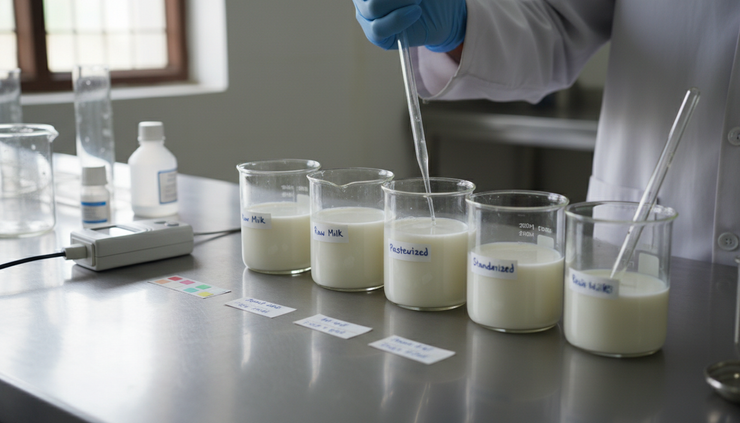
Good records matter because they prove that the plant follows its own procedures. Cleaning logs, water test reports, calibration certificates, pest control records, and batch sheets are often reviewed during audits.
Labelling and display rules
The Food Safety and Standards (Labelling and Display) Regulations, 2020 apply to packaged dairy products. Labels must be accurate, readable, and complete.
Typical label elements include:
Name of the food
List of ingredients
Nutritional information
Veg logo where applicable
Net quantity
FSSAI licence number
Batch or lot number
Date marking, such as manufacture, packing, use by, or best before, as applicable
Storage conditions
Name and address of manufacturer, packer, or marketer
Consumer care details
Allergen declaration where relevant
Instructions for use where needed
Dairy processors must also be careful with claims. Words such as “natural”, “fresh”, “pure”, “high protein”, “low fat”, “probiotic”, or “fortified” may trigger specific requirements. Claims must be truthful, supported, and permitted under applicable rules.
Labelling errors are expensive because they often affect every unit printed. Asiatic Traders reviews labels before production runs so corrections happen at artwork stage rather than after packaging stock has been purchased.
Packaging and food contact materials
Packaging must be suitable for food contact and must not contaminate the product. The Food Safety and Standards (Packaging) Regulations, 2018 set expectations for packaging materials used in food businesses.
Dairy processors should verify that films, cups, pouches, bottles, laminates, caps, tins, and tubs are food-grade and suitable for fat-rich or acidic dairy products where relevant. Supplier declarations, migration test reports, and material specifications should be maintained.
Plastic packaging may also bring obligations under plastic waste management rules, including Extended Producer Responsibility, depending on the nature and scale of the business.
Contaminants, residues, and adulteration controls
Dairy processors must control hazards at the raw milk stage and during processing. Rules on contaminants, toxins, and residues form a key part of food safety compliance.
Common control points include:
Screening raw milk for adulterants
Checking antibiotic residues where relevant
Monitoring pesticide or veterinary drug residue risks through supplier controls
Preventing cleaning chemical contamination
Controlling aflatoxin M1 risk through feed and milk sourcing practices
Maintaining microbiological safety through chilling, pasteurisation, and sanitation
Strong procurement standards are essential. A plant cannot correct every raw milk defect through processing. Asiatic Traders often supports processors in setting supplier approval criteria, collection-centre checks, and rejection procedures.
Traceability and recall readiness
The Food Safety and Standards (Food Recall Procedure) Regulations require food businesses to have systems that can identify affected products and withdraw them when needed. Dairy processors need batch traceability from raw milk receipt to finished goods dispatch.
A good traceability system answers practical questions quickly:
Which raw milk lots entered a finished product batch?
Which packaging material batch was used?
Which test results belong to the batch?
Where was the finished product dispatched?
Who approved release?
What stock remains at the plant, distributor, or retailer level?
Recall readiness is not only about crisis response. It also improves everyday quality control. When a complaint comes in, batch records can separate an isolated issue from a systemic one.
Standards that strengthen compliance beyond minimum law
The legal baseline is compulsory. Many dairy processors also adopt recognised standards to satisfy institutional buyers, retail chains, export customers, or quality-conscious consumers.
HACCP and ISO 22000
Hazard Analysis and Critical Control Point principles help dairies identify food safety hazards and control them at defined points. In dairy processing, critical controls may include pasteurisation time and temperature, cold storage temperature, cleaning cycles, metal detection where applicable, and final product release testing.
ISO 22000 builds a food safety management system around hazard control, documented procedures, communication, and continual improvement. Certification is not mandatory for every dairy business, but it can help when supplying organised retail, airlines, hotels, food service companies, or export markets.
BIS and product-specific standards
Some dairy-related products and processes may interact with Bureau of Indian Standards requirements or voluntary Indian Standards, especially where buyers specify them. Processors should check whether a specific product, equipment, testing method, or buyer contract requires BIS alignment.
Export requirements
Export-oriented dairy processors may need requirements beyond domestic FSSAI compliance. These can include importing country standards, export inspection, residue plans, plant approvals, health certificates, and additional documentation. The right compliance path depends on the destination country and product.

How Asiatic Traders supports dairy processors
Asiatic Traders helps processors convert regulatory requirements into workable plant-level systems. The support is practical because it connects licences, documentation, training, records, product standards, and inspections.
Compliance consultation
Consultation usually begins with understanding the processor’s products, plant layout, capacity, sourcing model, packaging, and sales channels. Based on this review, Asiatic Traders helps identify applicable requirements and priority gaps.
Support can include:
FSSAI licence and modification guidance
Product category mapping
Label and claims review
Documentation planning
Supplier compliance review
Pre-launch compliance checks for new dairy products
Guidance for expansion into new states or sales channels
This helps businesses avoid common errors, such as using the wrong product name, missing licence modifications, or launching products before testing and labelling are complete.
Training for plant teams
Compliance works only when people follow it on the floor. Asiatic Traders provides training for production staff, quality teams, supervisors, procurement teams, and management.
Training areas may include:
Food safety basics for dairy operations
GMP and GHP practices
Personal hygiene and plant sanitation
Raw milk acceptance checks
Cleaning and sanitisation procedures
Batch documentation
Allergen and cross-contamination controls
Recall and complaint handling
FSSAI inspection readiness
Training also helps reduce dependence on one quality manager. When operators understand why records, temperatures, cleaning cycles, and sampling matter, compliance becomes part of routine work.
Compliance audits and gap reports
Audits help processors see their plant as an inspector, buyer, or certification auditor would see it. Asiatic Traders reviews records, processes, storage, testing systems, hygiene practices, labels, licences, and statutory documents.
A useful audit does not only list non-compliances. It ranks them by risk and gives a correction path. For example, an audit may separate urgent safety issues from documentation gaps and long-term infrastructure needs.
Typical audit outputs include:
Gap assessment against FSSAI and buyer requirements
Review of plant hygiene and process controls
Verification of records and batch traceability
Label and packaging compliance observations
Corrective action plan
Follow-up support after fixes are made
Documentation and inspection preparation
Many dairy businesses perform good work but fail to document it well. Asiatic Traders helps set up practical documentation systems that match the size of the operation.
Examples include SOPs, sanitation schedules, raw milk testing sheets, batch manufacturing records, dispatch logs, calibration schedules, training records, complaint registers, recall plans, and internal audit formats.
Good documentation should be easy to maintain. If a small dairy plant receives a 40-page form for a simple daily check, the system will fail. Asiatic Traders focuses on formats teams can actually use.
Examples of successful compliance support
The following anonymised examples show how structured support from Asiatic Traders can help dairy processors resolve common compliance problems without disrupting business.
A regional paneer and curd maker corrected product and label gaps
A growing dairy processor had expanded from liquid milk into paneer and curd. The plant had an FSSAI licence, but the product categories and label declarations needed review. Some labels used marketing descriptions that did not fully match the regulatory product identity.
Asiatic Traders reviewed the licence scope, product formulations, label artwork, and batch records. The team helped align product names, ingredient declarations, storage instructions, and date marking practices. Staff also received training on batch traceability and finished product release.
The processor entered new retail counters with cleaner documentation, corrected packaging, and fewer buyer queries.
A milk collection network improved raw milk controls
A processor sourcing milk from multiple collection points faced variation in raw milk quality. Rejections were inconsistent, and collection staff used different testing practices.
Asiatic Traders helped define acceptance criteria, testing steps, record formats, and escalation rules. Collection teams were trained on sampling discipline, temperature checks, adulteration screening, and transport hygiene.
The plant gained better visibility into supplier quality. The quality team could identify repeat issues by collection point and take corrective action before poor-quality milk entered production.
A ghee manufacturer prepared for a buyer audit
A ghee manufacturer supplying bulk packs to institutional buyers needed stronger documentation. The processing system was stable, but maintenance logs, cleaning records, packaging material approvals, and traceability files were not audit-ready.
Asiatic Traders conducted a compliance audit, created a correction plan, and supported the team through documentation improvements. The business standardised batch records, packaging checks, and finished product release procedures.
The buyer audit became easier because the plant could show consistent evidence for process control, hygiene, and traceability.

A practical compliance checklist for dairy processors
A useful compliance plan should cover both legal requirements and operating discipline. Dairy processors can begin with this checklist:
Compliance area | What to verify |
FSSAI licence | Correct licence type, valid status, correct address, capacity, and product categories |
Product standards | Formulation and product identity match applicable FSSAI standards |
Labels | Mandatory declarations, claims, date marking, storage instructions, and FSSAI number are correct |
Hygiene | GMP, GHP, sanitation, pest control, and personal hygiene are documented and followed |
Testing | Raw milk, in-process, finished goods, water, and packaging checks are defined |
Records | Batch sheets, cleaning logs, calibration records, dispatch data, and training records are current |
Traceability | Raw material to finished goods and dispatch trail can be traced batch-wise |
Packaging | Food-grade declarations and packaging suitability records are available |
Statutory permissions | Pollution control, legal metrology, labour, boiler, and other applicable approvals are reviewed |
Audits | Internal audits and corrective actions are documented |
The best time to fix compliance gaps is before a licence renewal, inspection, product launch, or buyer audit. Waiting until a notice arrives creates stress and often costs more.
The takeaway for dairy businesses
Dairy processing compliance in India is a daily responsibility that covers food safety, product standards, labelling, packaging, hygiene, traceability, and statutory approvals. Strong compliance protects consumers and gives processors a stronger position with retailers, institutions, regulators, and export customers.
Asiatic Traders supports dairy processors with consultation, training, compliance audits, documentation, and inspection readiness. The value lies in making regulations workable at plant level. When teams understand the rules and records reflect real practice, compliance becomes a strength rather than a burden.


Comments